
When you need more space at home, two options dominate the conversation: build a house extension, or add a garden room. Both create usable square metres, but they solve different problems, carry different costs, and suit different lifestyles.
This guide compares garden rooms and extensions honestly, so you can decide which approach is right for your Hertfordshire home.
What each option provides
House extension
An extension adds space directly to your existing home — typically a rear kitchen extension, side return, or loft conversion. It increases the footprint of the main dwelling, integrates with existing rooms, and is accessed from within the house.
Best for: expanding the kitchen, creating open-plan living, adding a bedroom or bathroom to the main house.
Garden room
A garden room is a separate building within your garden, connected to the main house only by services (electricity, water, data). It has its own entrance and functions as an independent space.
Best for: home office, creative studio, gym, guest accommodation, garden annexe, entertaining space.
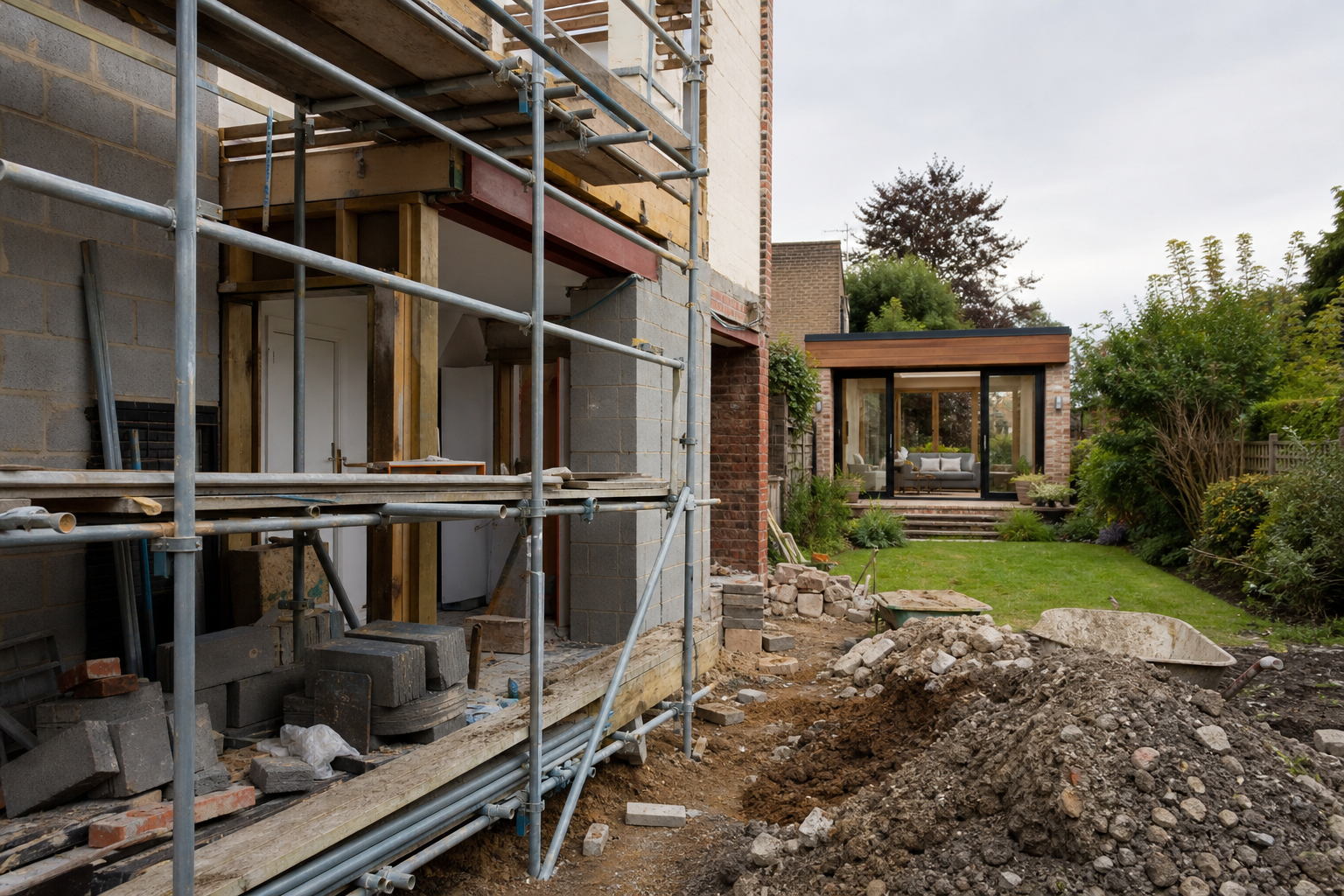 Garden rooms typically involve less disruption and faster completion than extensions.
Cost comparison
| Factor | Garden room | Extension |
|---|---|---|
| Typical cost per sq m | £2,000–£3,500 | £2,500–£4,500+ |
| 15 sq m project | £30,000–£50,000 | £40,000–£70,000+ |
| VAT | Often 0% (new dwelling annexe) or 20% | 20% standard rate |
| Hidden costs | Service connections, pathway | Structural work, redecorating existing rooms |
Garden rooms are generally more cost-effective per square metre, particularly for self-contained spaces that do not need to integrate with the existing floor plan. Extensions carry additional costs for structural alterations, matching existing finishes, and redecorating affected rooms.
For detailed garden room pricing, see our guide to garden room costs in Hertfordshire.
Planning and regulations
Garden rooms
Many garden rooms fall within permitted development — no planning application required if size and position meet criteria. Garden annexes with sleeping accommodation typically need planning permission. Building regulations apply above certain size thresholds.
Extensions
Most extensions require planning permission or a lawful development certificate. Building regulations always apply. Party wall agreements may be needed for terraced and semi-detached properties — common across Hertfordshire.
Garden rooms often have a simpler planning route, particularly for garden offices and studios. Our guide to garden room planning permission covers the detail.
Disruption and timeline
Garden room
- Construction happens in the garden — no dust, noise, or workers inside your home
- Typical timeline — 6–12 weeks from design approval to handover
- You live normally throughout the build
- No redecoration of existing rooms required
Extension
- Construction affects your daily life — kitchen out of action, rooms used as storage, dust throughout
- Typical timeline — 3–6 months including design and approvals
- Existing rooms disrupted — often the kitchen, dining, or living room
- Redecoration needed in adjoining spaces
For homeowners who cannot face months of disruption, a garden room is often the pragmatic choice.
Flexibility and future use
Garden rooms offer flexibility that extensions cannot match:
- Change of use — today’s office becomes tomorrow’s studio, gym, or teenager’s retreat
- Separate entrance — visitors, clients, or family members come and go without passing through the house
- Potential income — some garden rooms can generate rental income (subject to planning and tax advice)
- Reversibility — removing a garden room is far simpler than removing an extension
Extensions are permanent alterations to your home’s structure. They add value but reduce flexibility.
When an extension is the better choice
A garden room is not always the answer. Choose an extension when:
- You need the new space connected to existing rooms (open-plan kitchen-diner)
- You need a bedroom or bathroom within the main house
- Your garden is too small for a separate building
- You want to increase the overall property footprint for resale value in a specific way
When a garden room is the better choice
Choose a garden room when:
- You need a separate, independent space (office, studio, annexe)
- You want to avoid disruption to daily home life
- Your garden has adequate space and good access
- You value flexibility in how the space is used over time
- You want a faster, simpler planning route
The hybrid approach
Some Hertfordshire homeowners do both — a modest extension for the kitchen and a garden office for working from home. The two projects can be sequenced to minimise disruption, and each solves a distinct need.
Explore your options
Browse garden rooms we have designed and built across Hertfordshire in our gallery. For bespoke design tailored to your plot and lifestyle, book a consultation — we will help you decide whether a garden room, an extension, or a combination is the right investment.

